No products in the cart.
Which flowers come in purple, burgundy and deep red?
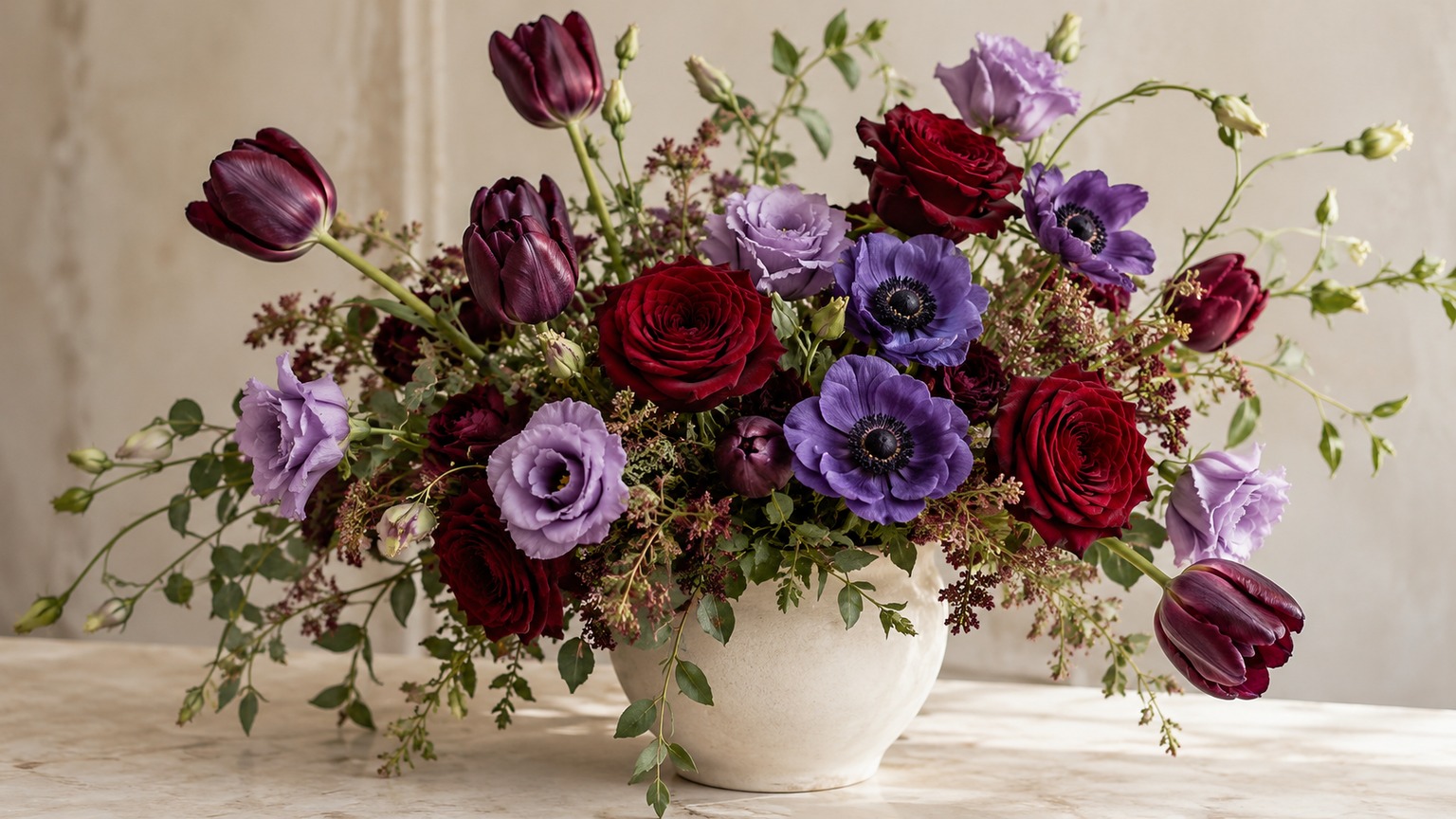
Purple and deep red are ranges rather than single shades, and the colour belongs to the variety rather than the flower type. Lisianthus, anemones and dark tulips cover purple from pale lavender through to maroon. Named varieties of dahlia, scabiosa and calla provide darker red tones. A purple flower bouquet can combine several shapes, or concentrate on one. The choice is part of the design, rather than a rule about what looks better.
Lavender and plum can both sit under a purple heading, yet suggest quite different arrangements. Naming the shade and flower form gives more detail than the colour category alone. A named variety is more specific again, and its availability needs checking for the date.
Which flowers are naturally purple?
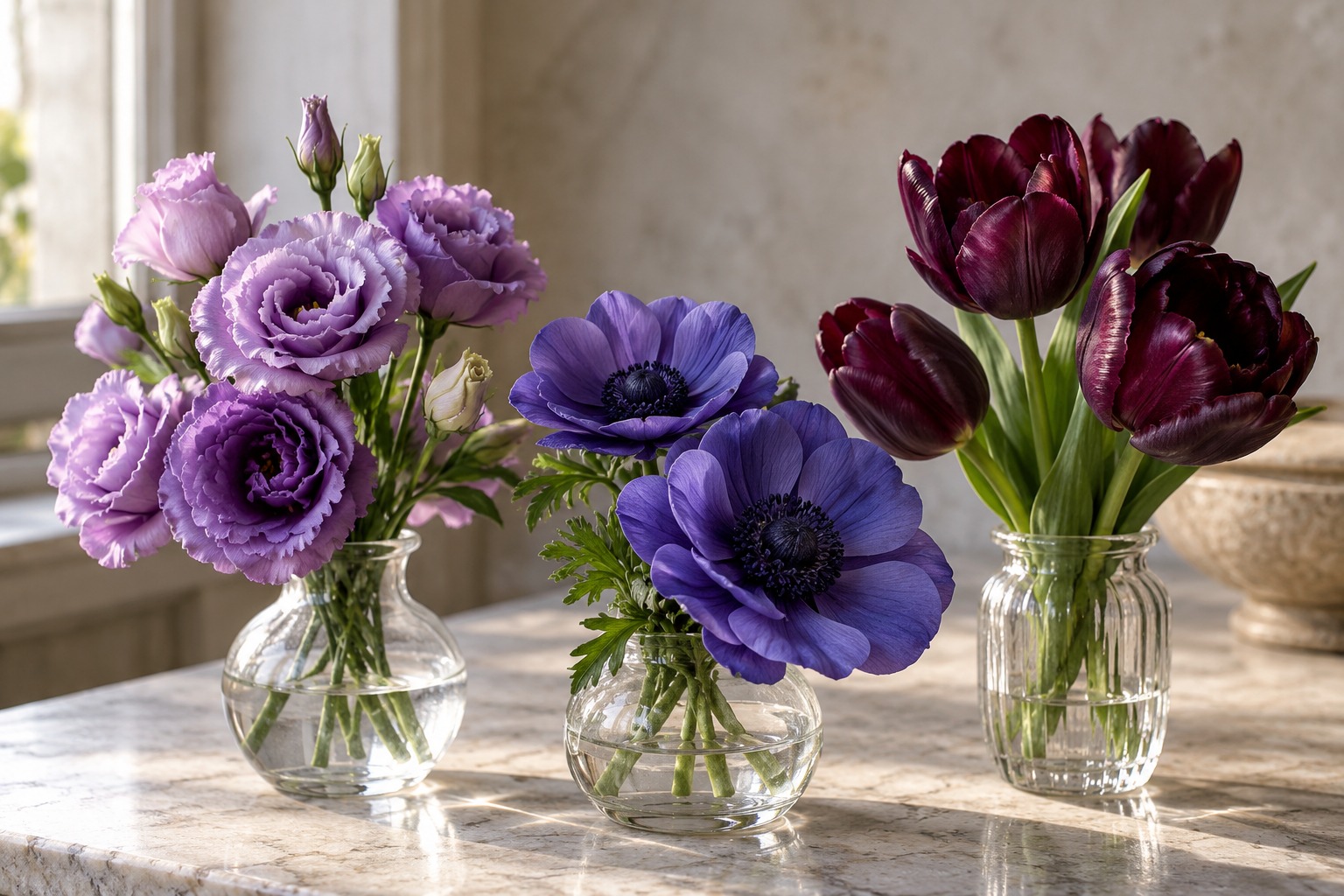
Purple in flowers covers a band of shades. Pale lavender, violet-blue, plum and red-purple all sit inside it. Three cut flowers show that range well.
North Carolina State University’s plant guide describes lavender and blue-violet lisianthus forms and their use as cut flowers. The Royal Horticultural Society describes the anemone and tulip examples below. Their shapes make the differences easier to picture.
| Flower example | Published colour description | Flower form |
|---|---|---|
| Lisianthus | Lavender, with blue-violet forms among cultivars | Bell-shaped flowers; double forms also exist |
| Anemone coronaria | Violet-blue, alongside red and white forms | Shallow cups; double-flowered cultivars also exist |
| Queen of Night tulip | Glossy dark purple to maroon | Cup or goblet-shaped flowers on tall stems |
Those are different choices within the same broad colour family. Lisianthus need not look like a dark tulip just because both are described as purple. Nor does the species name establish the shade: a red or white anemone belongs to the same species as the violet-blue example.
These are examples of what the colour looks like in real flowers. They are not a list of what is in any shop on a given day.
Which flowers are burgundy or deep red?
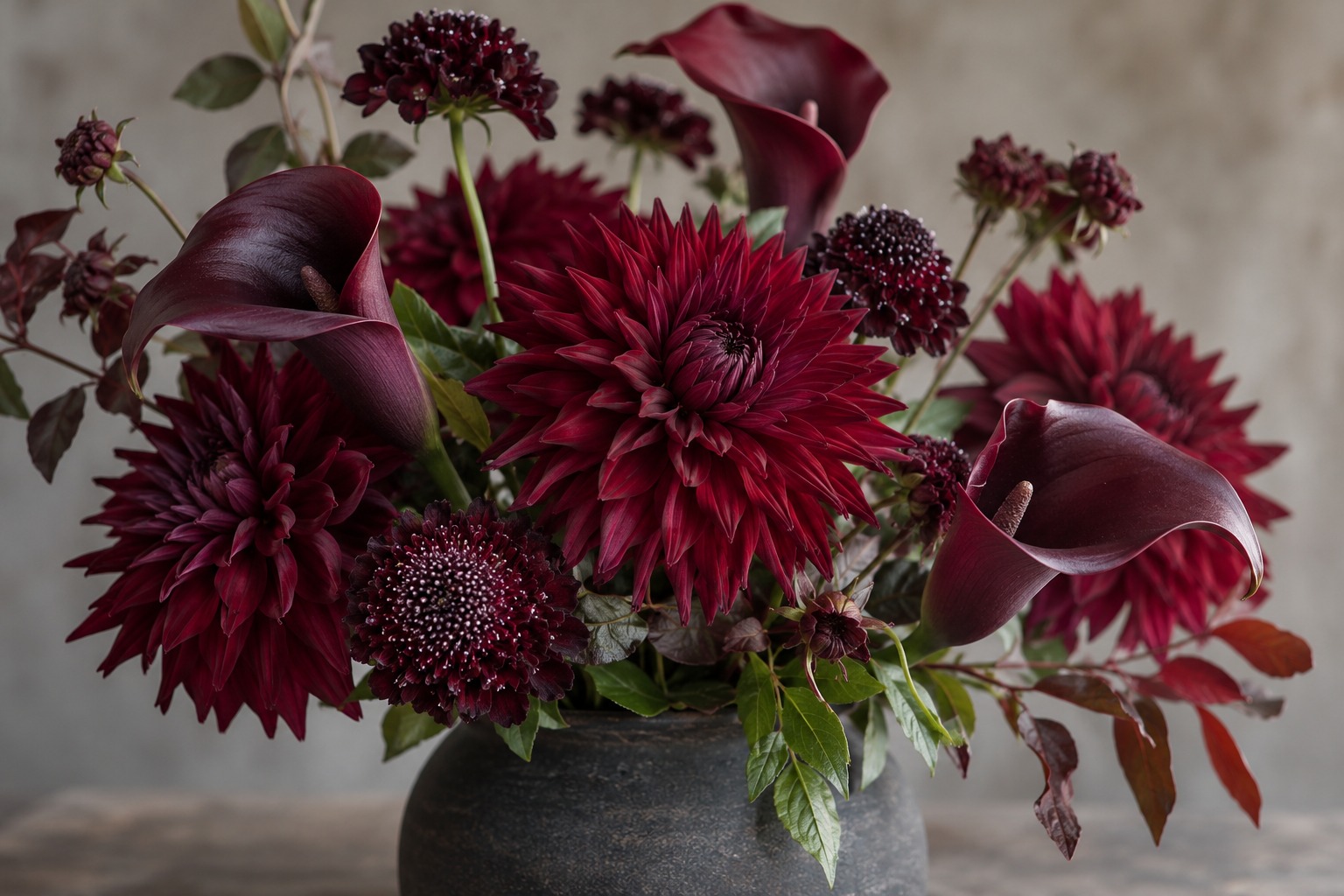
Burgundy and deep red cover the dark end of the red range. Shape matters here as much as shade, so a short set of very different flowers is the clearest way to see it.
The RHS descriptions give three distinct examples:
- Dahlia Chat Noir has rich red-purple flowerheads, tinged with grey towards the centre. Its fully double, semi-cactus form has narrow, pointed petals.
- Scabiosa atropurpurea Chat Noir has very dark red, scented flowers on long, sturdy stems. It offers a different form from the dense dahlia head.
- Calla Black Star, also listed as Edge of Night, is described as dark maroon-red to black. Its showy part is a spathe, the hood-shaped wrap around the central spike.
Roses belong here as well. The Royal Horticultural Society’s own plant shop describes the rose Black Baccara as an exceptionally deep red. It can appear almost black in certain light.
Not every dark flower is burgundy. Red-purple, very dark red and maroon-red are three different things in the hand. Use the shade you mean rather than treating those descriptions as interchangeable.
Are black flowers real?
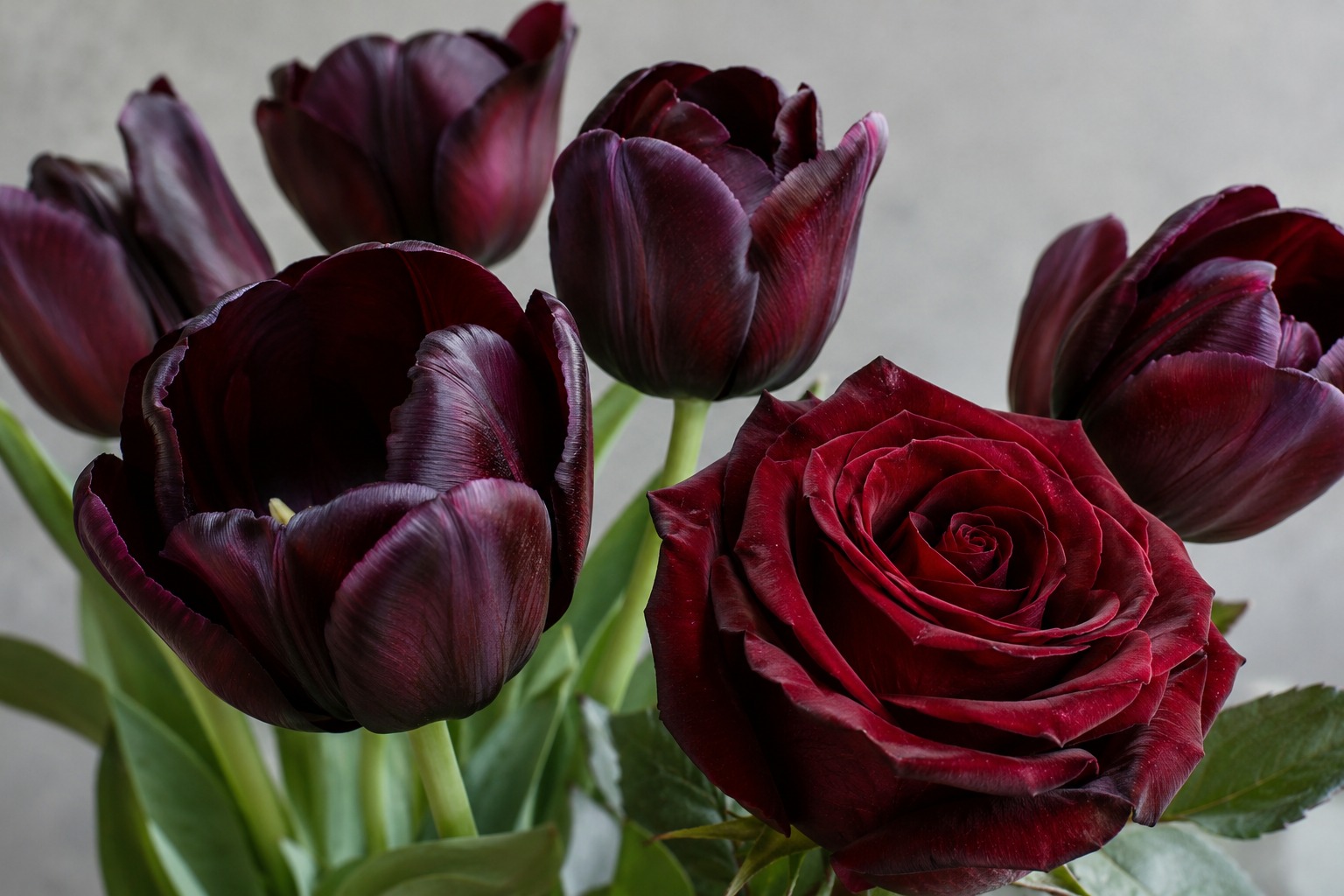
A black name does not tell you the exact colour of a flower. The variety description is more useful. The RHS calls Queen of Night dark purple to maroon, while Black Star is described as dark maroon-red to black. These examples do not establish a rule that every flower called black is purple, red or dyed.
For a very dark arrangement, the distinction still matters. Plum and maroon are different colour directions. A near-black appearance in one named variety is not a promise about every bouquet or how a phone will photograph it.
Are purple flowers dyed?
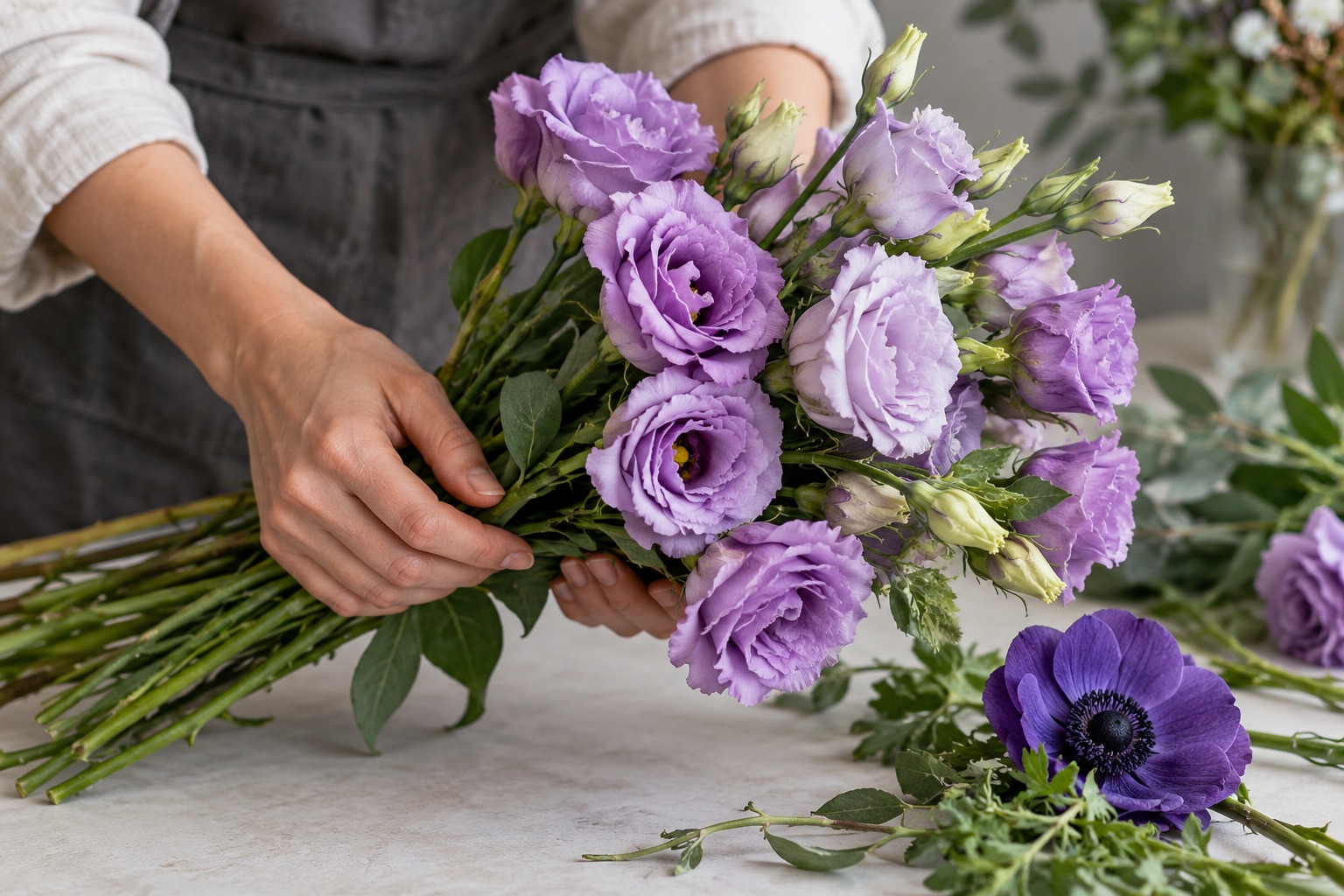
Purple occurs naturally in the varieties described above. Post-harvest colour treatments also exist, so the colour name alone does not establish how a particular stem was produced.
Treatments are a separate trade. Design Master manufactures floral colour products. It publishes a transparent dye spray for fresh flowers, and a stem-absorption dye that a flower draws up through its stem. One sits on the bloom. The other travels into it.
An unusual shade alone does not establish whether a stem has been treated. If natural colour matters to you, say so when you order, and ask what the stems are.
Single-colour and colour-led arrangements
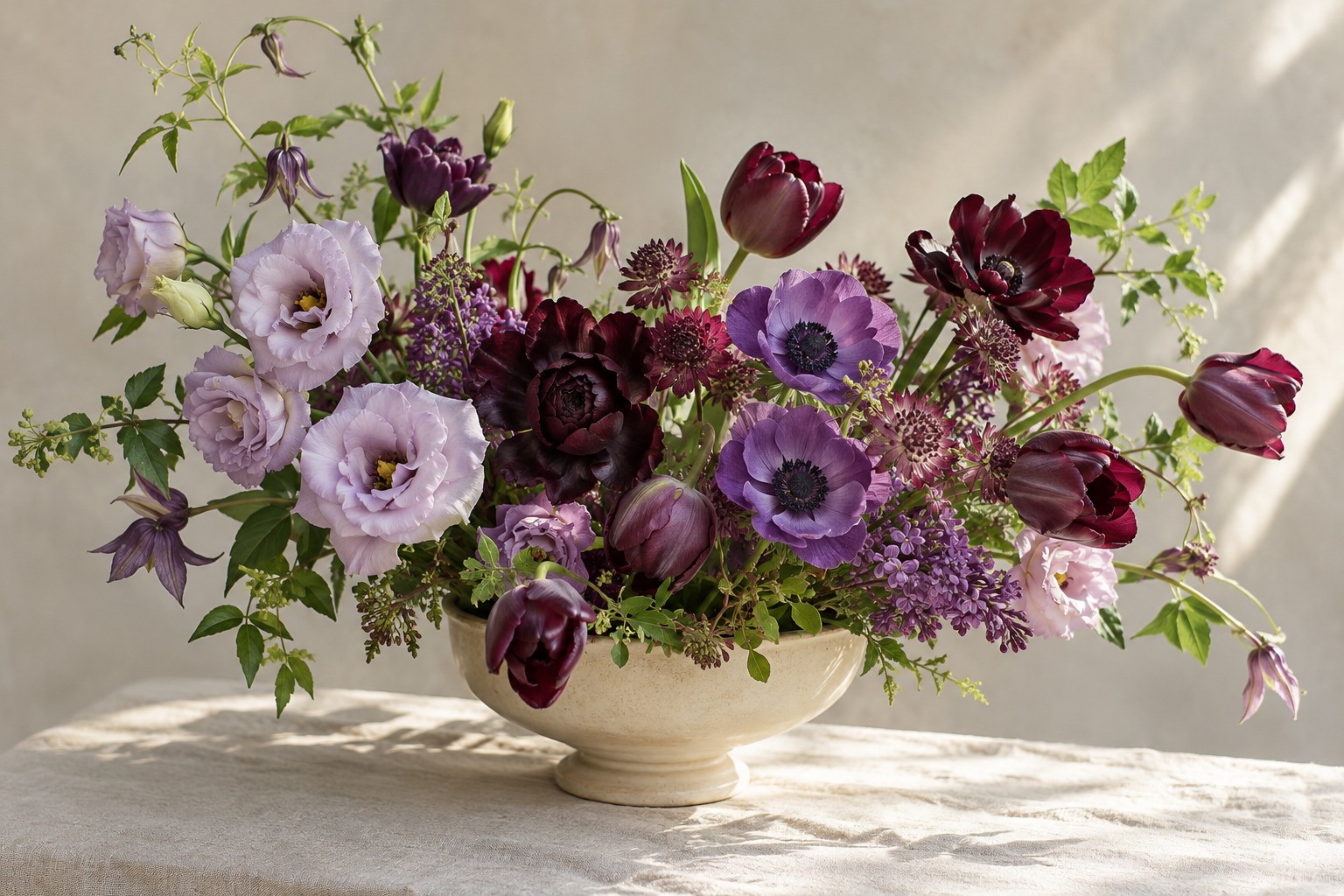
A single-colour arrangement holds one hue and lets the flower shapes carry the variety. A colour-led arrangement works to a palette instead. It moves between lighter and darker tones in the same family. That is the difference between a purple flower bouquet built from one shade and one built from a range.
Both are design decisions about how an arrangement is put together. Neither is a rule about what suits a particular room, gift or event.
Our Violet bouquet is one published example of a colour-led design, described as a dark purple theme. The notice on its page says varieties may vary with the season, while the colour palette and the value of the bouquet are kept. The purple collection groups the current designs by colour. A shared heading does not mean that every bouquet has the same ingredients or exact shade.
Which purple and burgundy flowers are seasonal?
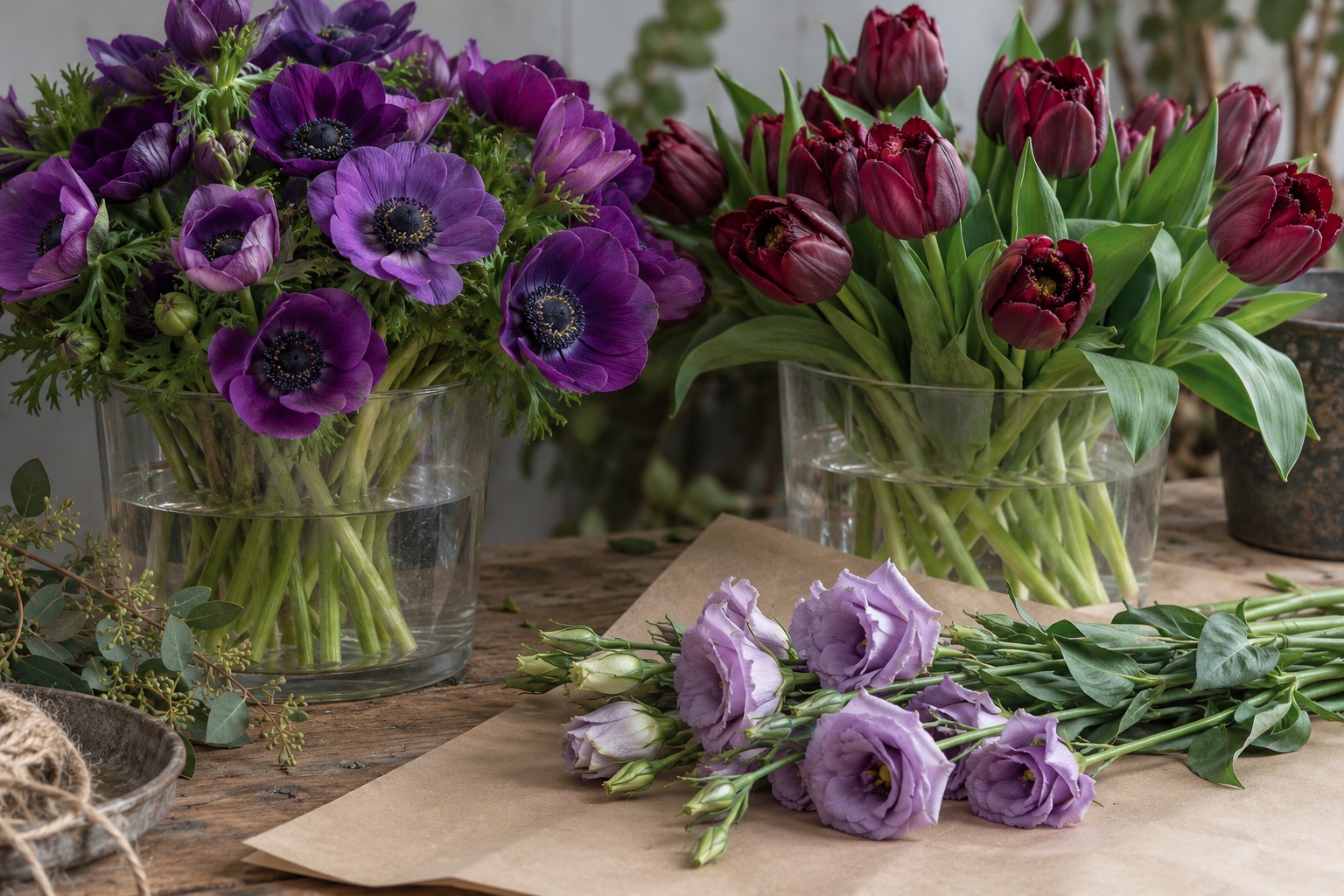
A growing season and a florist’s supply are two different things. A plant guide describes when a crop flowers under particular conditions. It does not establish what one shop can supply on a particular day.
Grow It Australia, an Australian cut-flower supplier, describes its Italian anemones as a cool-season flower. Its guide describes flowering in late winter and spring, with timing affected by temperature and planting date. That is Australian growing guidance, not a promise that every variety will be available throughout that window.
Allowing different varieties within a colour family can leave more room for seasonal choice. Requesting Queen of Night tulips narrows that choice to one cultivar. Neither request guarantees supply; the actual offer for the date still needs confirmation. If burgundy flowers are the plan, the burgundy collection shows the current designs. Availability for a particular date still needs checking.
If an exact shade or named variety matters for a fixed date, check availability before ordering. A reference photograph helps describe the colour, but it does not confirm which stems can be supplied. Ring Monet de Fleur in Camberwell on 03 9813 2002, give the date and the colour, and ask what is possible.